


上周末单增先生于《易象》展厅现场主持了一场作品分享会
Last weekend Mr. Shan Zeng hosted an on-site artwork sharing session at the “Mirage” exhibition hall.
单增先生分享了他从杭州西湖到德国柏林~双重视角下的艺术创作历程;
围绕“乾坤”系列对卦象、阴阳、变易的抽象演绎,他亲自阐释水墨、水彩、油画不同媒介对同一主题的探索,通过形、色、质的极简处理,传达“大象无形”的哲学观。帮助观众理解其中艺术语言的实验性与系统性。
Mr. Shan Zeng shared his artistic journey from Hangzhou’s West Lake to Berlin, Germany, presenting his creative process through
a dual perspective.
Centered on the Qian–Kun series, he offered an abstract interpretation of hexagrams, yin and yang, and the principle of change, he elaborated in person on the exploration of the same theme across different media—ink wash, watercolor, and oil painting. Through minimalist treatments of form, color, and texture, he conveys the philosophical idea that “the greatest image is formless,” helping the audience better understand the experimental and systematic nature of his artistic language.
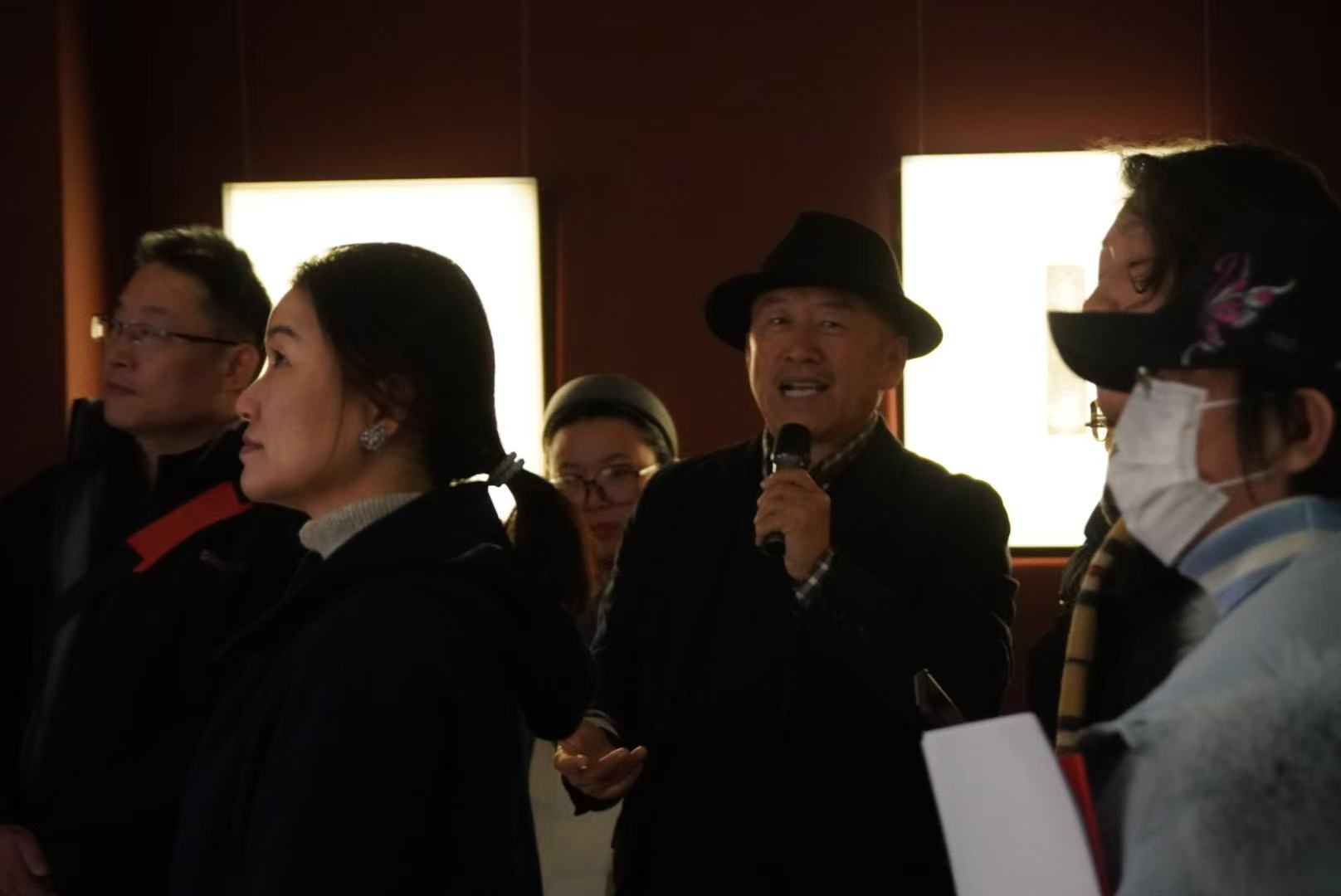
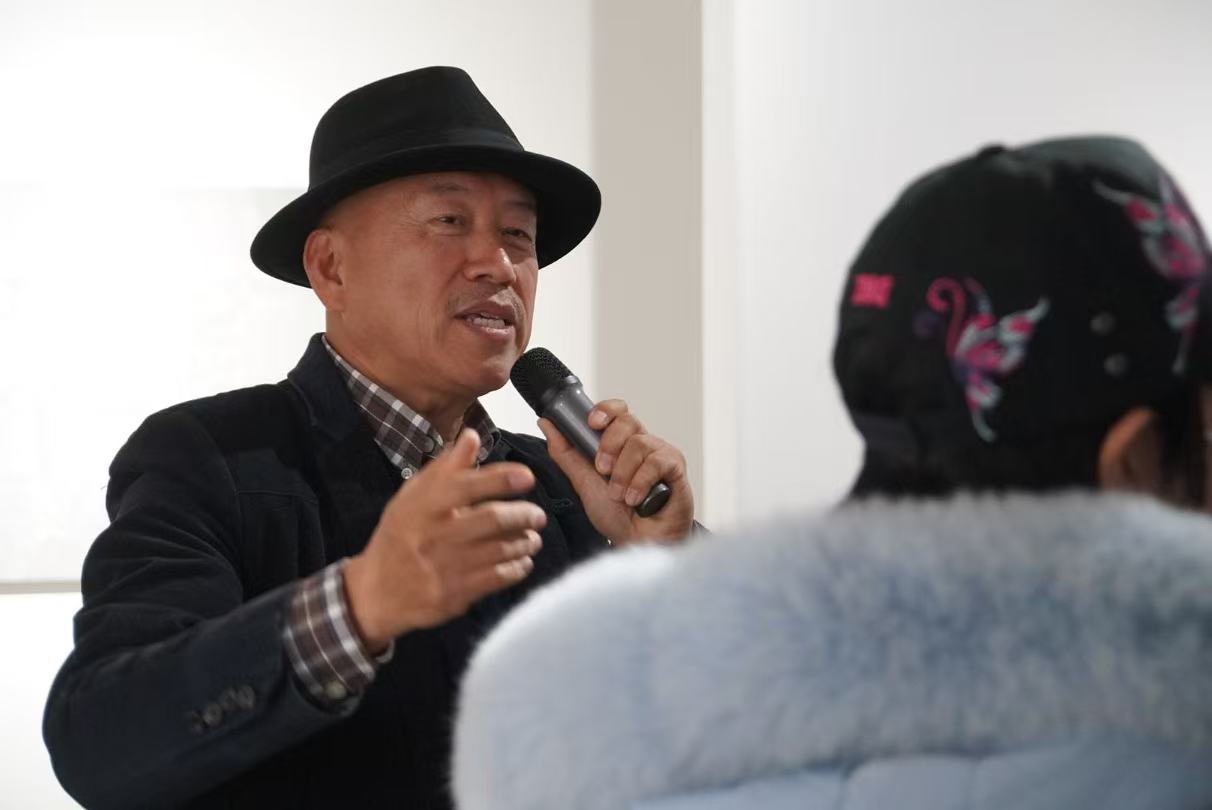
分享会的下半场由法国艺术文化管理学院中国校区的包海鹰校长主持,邀请了德国艾菲德艺术中心名誉馆长张錡玮博士、单增教授(中国美术学院艺术管理与教育学院创院副院长),以及礼巴堂的主理人汪晓蓉女士,通过问与答的对谈方式,一同探讨跨文化交流、文化艺术价值观及文化身份认同等话题。
The second part of the art sharing session was moderated by Ms. Bao Haiying, President of the China Campus of the French Institute of Art and Cultural Management. She invited Dr. Zhang Qiwei, Honorary Director of the German Schloss Eringerfeld Art Center; Professor Shan Zeng, Founding Vice Dean of the College of Art Management and Education at the China Academy of Art; and Ms. Wang Xiaorong, Director of Liberal Town Art Space. Through a Q&A-style dialogue, they jointly explored topics such as cross-cultural exchange, cultural and artistic values, and cultural identity.
现场问答摘要如下:
Summary of the On-site Q&A:
问:从事30年艺术创作,其中中德哲思不断碰撞,单增教授是如何在作品中平衡两种哲学思考的?
Q:Over 30 years of artistic practice, with continuous collisions between Chinese and German philosophical thought, how does Professor Shan Zeng balance these two philosophical approaches in your work?
答:艺术家通过感性感知世界,运用技术手段呈现想法,而哲学则通过思辨进行形而上的思考。语言学和图像学的差异使得两者之间的转换成为有趣的话题,阐释学和现象学与绘画艺术存在关联性。艺术家从哲学家的思辨中反思视觉艺术的力量,这种力量虽难以用图像清晰表达,却能呈现无形的可能性;艺术家虽偏向感性,但通过不同媒介传达思想,与哲学家用精准逻辑语言表达不同,艺术家使用模糊的非语言逻辑表达,但两者都追求内在认知;中国传统文化中诗画同源,体现思想与感性的结合,通过天人合一寻求多元呈现; 掌握多语种(中、德、和英语),有助于从不同文化视角理解问题,丰富艺术表达;写生过程中自然景象的流动变化激活艺术家的敏感度,照片的静止世界无法替代写生的鲜活体验。
A:Artists perceive the world through sensibility and use technical means to materialize ideas, while philosophy engages in metaphysical reflection through rational speculation. Differences between linguistics and iconography make the translation between the two an intriguing subject; hermeneutics and phenomenology are closely related to the art of painting. Artists reflect on the power of visual art through philosophical inquiry—a power that is difficult to articulate clearly through images, yet capable of revealing intangible possibilities. Although artists tend toward sensibility, they convey ideas through various media; unlike philosophers, who employ precise logical language, artists use ambiguous, non-verbal logic. Nevertheless, both pursue inner cognition. In traditional Chinese culture, poetry and painting share the same origin, embodying the integration of thought and sensibility, and seek pluralistic expressions through the unity of heaven and humanity. Mastery of multiple languages (Chinese, German, and English) helps artists understand issues from different cultural perspectives and enrich artistic expression. During the practice of painting from life, the flowing and changing aspects of nature heighten the artist’s sensitivity—an experience that cannot be replaced by the static world captured in photographs.
问:张錡玮博士,从学术角度看,您是如何看待跨国交流中的文化身份认同?
Q:Dr. Zhang Qiwei, from an academic perspective, how do you view cultural identity in the context of cross-national exchange?
答:创作并不需要刻意贴上文化标签。在中西文化的交融过程中,艺术表达往往会自然生成一种“互译”的状态。以单老师的创作为例,他在德国创作与展示作品时,常常需要向当地媒体解释《易经》、卦象以及自身的文化立场,包括如何将手持“长征”旗帜或异形卦象等元素融入艺术语言之中。然而,在这一跨文化互译的过程中,“误读”几乎不可避免:由于文化经验与知识结构的差异,某些意义必然会在转译中发生偏移、缺失或重组。但正是在这种不完全对等的理解中,绘画语言与作品自身所蕴含的张力反而显现出跨文化的共通性。艺术并不需要被逐字逐句地翻译,它通过形式、节奏、结构与情感强度直接作用于观看者。这种由差异与误读所构成的张力,形成了一种临界点上的碰撞,而正是这种碰撞,使作品呈现出高度的丰富性与饱满度,成为艺术活力的重要来源。正如印度后殖民理论学者Homi Bhabha提出的“文化杂柔”(hybridity)概念所揭示的那样,在不同文化相遇与摩擦的区间中,会生成一个“第三空间”。在这一空间中,艺术观念、文化转译与文化误读不再被视为问题或缺陷,而是作为创造性生成的条件,使新的意义结构与视觉经验得以诞生。
A:Artistic creation does not require the deliberate application of cultural labels. In the process of interaction between Eastern and Western cultures, artistic expression often naturally enters a state of “mutual translation.” Taking Professor Shan’s work as an example, when he creates and exhibits in Germany, he frequently needs to explain to local media the I Ching, hexagrams, and his own cultural standpoint, including how elements such as holding a “Long March” flag or using unconventional hexagram forms are incorporated into his artistic language.
However, in this process of cross-cultural mutual translation, “misreading” is almost inevitable. Due to differences in cultural experience and knowledge structures, certain meanings are bound to shift, be lost, or be reconfigured in translation. Yet it is precisely within this incomplete equivalence of understanding that the tension inherent in painterly language and in the work itself reveals a cross-cultural commonality. Art does not need to be translated word for word; it acts directly upon the viewer through form, rhythm, structure, and emotional intensity.
This tension, constituted by difference and misreading, creates a collision at a threshold point, and it is this very collision that endows artworks with a high degree of richness and fullness, becoming an essential source of artistic vitality. As articulated by Indian postcolonial theorist Homi Bhabha in his concept of “cultural hybridity,” a “third space” emerges in the zones where different cultures meet and rub against one another. Within this space, artistic ideas, cultural translation, and cultural misreading are no longer seen as problems or deficiencies, but rather as conditions for creative generation, enabling new structures of meaning and new visual experiences to come into being.
问:晓蓉,中德艺术交流中,您觉得两者的文化共通点是什么?
Xiaorong, in Sino-German artistic exchange, what do you see as the cultural common ground between the two?
答:两者均对古典传统尊重;运用各自的古典哲学与艺术交融;对工艺与技术持严谨态度。更愿意谈谈两者的差异性:两者艺术表达的哲学根基不同,德国受理性主义及现象学影响,艺术常体现对存在、秩序的探索;中国则根植于“天人合一”的自然观与写意美学,注重留白和气韵的表达。两者艺术创作方法不同,德国强调系统性、概念性,注重理论支撑;中国则偏重经验性和即兴,如文人墨客的直抒胸臆。德国注重政治反思,中国较少表达对抗性批判,侧重文人的个人修养和社会和谐。两者审美习惯不同,德国观众可能更适应直喻、抽象的形式语言;中国观众则对隐喻、象征性符号(如梅兰竹菊)有文化本能的理解。
Q:Both cultures share a deep respect for classical traditions, integrate their respective classical philosophies with artistic practice, and maintain a rigorous attitude toward craftsmanship and technique.
I would, however, like to speak more about their differences. The philosophical foundations of artistic expression differ significantly: German art is influenced by rationalism and phenomenology, often reflecting explorations of existence and order; Chinese art, by contrast, is rooted in the natural worldview of the “unity of heaven and humanity” and in xieyi (freehand) aesthetics, emphasizing the use of emptiness and the expression of qi and resonance.
Their approaches to artistic creation also differ. German art tends to emphasize systematic and conceptual methods, with strong theoretical grounding, while Chinese art places greater weight on experience and improvisation, akin to the spontaneous expression of the literati. In terms of social orientation, German art places greater emphasis on political reflection, whereas Chinese art is less confrontational or overtly critical, focusing more on the artist-scholar’s personal cultivation and social harmony.
Aesthetic habits likewise diverge: German audiences may be more accustomed to direct metaphors and abstract formal languages, while Chinese audiences have an intuitive cultural understanding of metaphorical and symbolic imagery, such as the plum blossom, orchid, bamboo, and chrysanthemum.
